Why a String Quartet Is the Perfect Choice for Corporate Events in NYC
For executive dinners, client receptions, awards galas, luxury brand activations, and other high-level corporate events in New York City, a professional string quartet offers something few forms of entertainment can match: presence without intrusion.
The ensemble immediately changes how a room feels. Guests recognize that the experience has been considered carefully, yet the music does not need to dominate the evening. A well-directed quartet can welcome arrivals, create momentum during a reception, underscore a brand moment, soften transitions, and maintain an elevated atmosphere while allowing conversation to remain central.
That balance is what makes live strings particularly effective in corporate environments.
The best corporate event music is not simply impressive. It is calibrated to the purpose of the gathering, the profile of the guests, the acoustics of the venue, and the natural flow of the room. At The J.M. Chamber Players, we approach each engagement with that larger responsibility in mind.
This guide explains when a string quartet is the right choice for a corporate event in NYC, when a trio may be more appropriate, what repertoire works best, which logistical details matter, how pricing is determined, and what distinguishes a premium professional ensemble from a group that simply arrives and plays.
“The best corporate event music does not compete with the room. It gives the room an identity.”
In This Guide
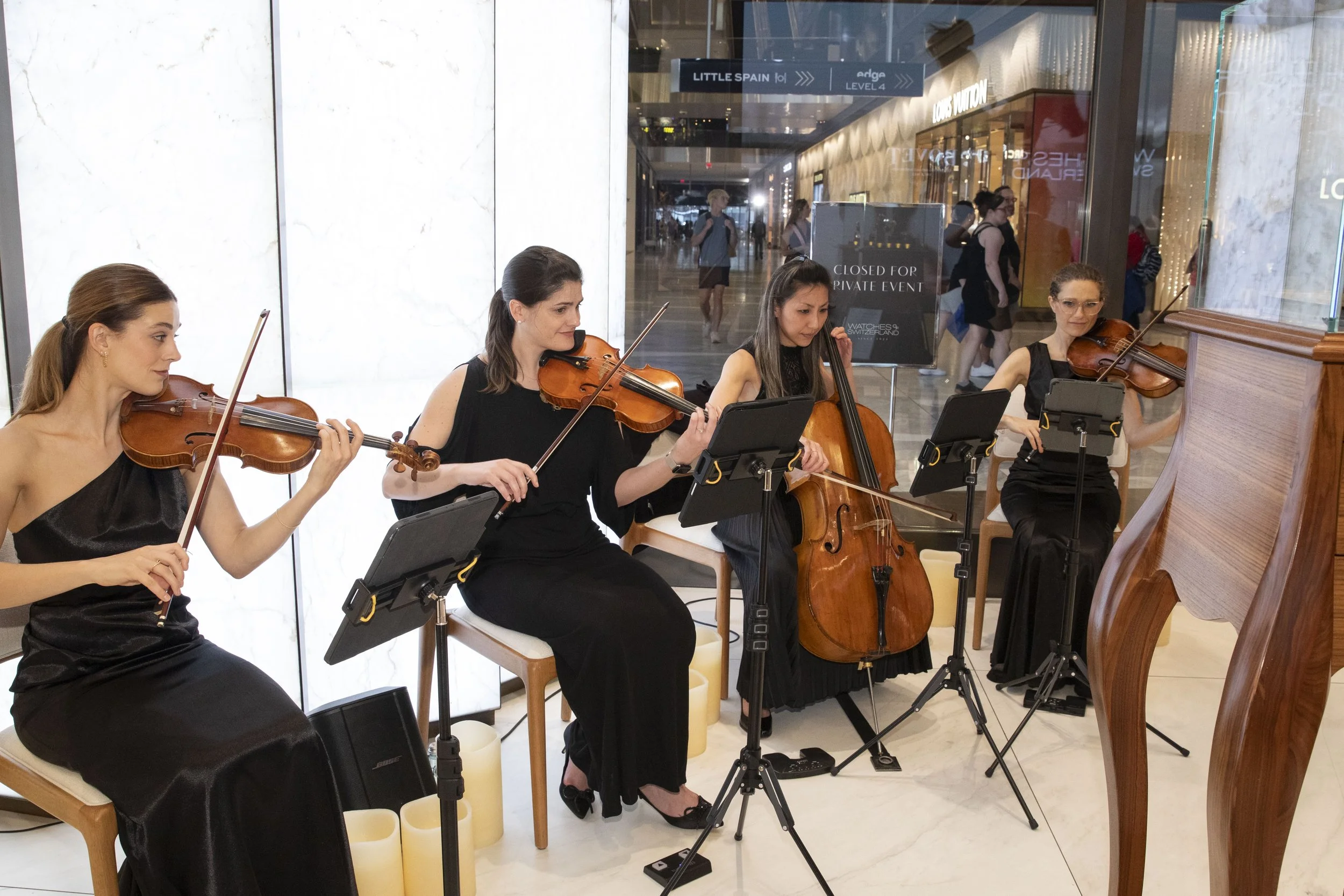
The J.M. Chamber Players creates tailored live-music experiences for corporate events throughout New York City.
Is a String Quartet a Good Choice for a Corporate Event?
A string quartet is an excellent choice for a corporate event when the host wants the setting to feel sophisticated, intentional, and welcoming without turning the evening into a concert.
The traditional quartet consists of two violins, one viola, and one cello. Together, those instruments create a complete and flexible sound: brilliant enough to carry through a reception, warm enough for a seated dinner, and detailed enough to make familiar contemporary music feel newly refined.
Unlike a playlist, live musicians respond to the room in real time. Unlike many amplified bands or DJs, a string quartet can add energy without automatically raising the conversational volume of the entire event.
A quartet works especially well when the desired atmosphere is:
Elevated but not theatrical
Contemporary but not trend-driven
Impressive without feeling ostentatious
Warm enough for hospitality
Polished enough for executives, clients, donors, press, or luxury consumers
Adaptable across arrivals, cocktails, dinner, presentations, and departures
The question is not whether string music is “formal.” The more useful question is whether the ensemble, repertoire, styling, and performance approach are appropriate for the occasion.
A quartet playing Mozart in traditional concert attire creates one impression. The same quartet performing tasteful arrangements of Alicia Keys, Coldplay, Stevie Wonder, David Bowie, or contemporary film music creates another. Repertoire, pacing, attire, sound level, and presentation can all be adjusted to support the identity of the event.
Why String Quartets Work So Well in Corporate Environments
Corporate events often have several objectives operating at once. The host may want to impress clients, encourage networking, communicate a brand value, recognize employees, support a fundraising mission, or create a memorable experience for senior stakeholders.
Music must support those objectives rather than distract from them.
Live strings create immediate atmosphere
Guests begin interpreting an event within moments of entering the room. Lighting, service, décor, sound, and staff presence all contribute to that first impression.
A live string quartet establishes a sense of occasion immediately. It signals that the host has invested not only in the physical environment but also in how guests will feel within it.
That effect is especially valuable in spaces that can otherwise feel neutral or transitional, including corporate offices, hotel pre-function areas, conference venues, showrooms, and private dining rooms.
A quartet feels premium without feeling impersonal
Luxury is not always about scale or spectacle. In many executive and private-client environments, luxury is expressed through precision, restraint, quality, and attention to detail.
Four exceptional musicians performing a carefully curated program can feel more personal and considered than a large entertainment production. Guests can see the music being created in front of them, but the experience remains composed and appropriate to the room.
String music can support conversation
For networking receptions and dinners, music should create atmosphere without forcing guests to compete with it.
Acoustic strings can often operate at a more comfortable level than heavily amplified entertainment. When amplification is needed, it can be applied with restraint and adjusted to the space.
Placement also matters. A quartet positioned directly beside a crowded bar will behave differently from one situated near an arrival point, architectural feature, or quieter end of the room. A premium provider should consider how guests will move, where conversations will naturally form, and how sound will travel before determining the final setup.
The repertoire can cross generations
Corporate guest lists frequently include a wide range of ages, industries, cultural backgrounds, and musical preferences.
A strong string repertoire can move naturally among classical works, jazz standards, soul, pop, rock, film music, and contemporary selections without making the evening feel fragmented. Familiar melodies can create recognition and warmth, while the string instrumentation gives the program a consistent sonic identity.
Live musicians can adapt to event flow
Corporate timelines change. A speech may run long. Dinner service may be delayed. Guests may arrive earlier than anticipated. A presentation may require a quieter transition.
Experienced corporate event musicians can adjust pacing, extend or shorten selections, pause cleanly, restart at an appropriate moment, and coordinate with the planner or production team.
That operational awareness is as important as musical ability.
The Corporate Music Test
Before choosing entertainment, ask three questions:
Will it improve the atmosphere?
Will guests still be able to communicate comfortably?
Can the provider adapt professionally when the timeline changes?
If the answer to all three is yes, the music is supporting the event rather than merely occupying it.
Which Corporate Events Benefit Most From Live Strings?
A string quartet can serve many corporate formats, but its role should change according to the purpose of the event.
Executive dinners
At an executive dinner, music should create warmth and distinction without becoming the focal point.
A quartet or trio can perform during arrivals and cocktails, then reduce volume or reposition as guests sit for dinner. Repertoire should feel polished and recognizable, but not overly sentimental or celebratory unless the occasion calls for it.
For smaller private dining rooms, a trio may provide sufficient depth while occupying less space. In a hotel ballroom, private club, townhouse, or larger restaurant buyout, a quartet can give the room greater visual and musical presence.
Client appreciation events
Client events benefit from entertainment that feels generous but still allows relationships to remain central.
Live strings can welcome guests, support conversation, and create subtle moments of recognition through thoughtfully selected songs. A program might incorporate repertoire associated with the company, city, season, or guest profile without turning the evening into a branded performance.
The objective is to make clients feel hosted rather than marketed to.
Networking receptions
The greatest risk at a networking reception is choosing music that makes networking more difficult.
A string ensemble can energize the environment without creating the same low-frequency buildup or high-volume escalation that often occurs with amplified entertainment. The musicians should be placed away from conversational bottlenecks and briefed to maintain a controlled dynamic level.
For an especially conversation-focused event, a trio may be ideal. For a large reception, gala arrival, or visually prominent performance position, a quartet may provide the necessary scale.
Luxury brand activations and retail events
For a luxury brand, music becomes part of the brand environment.
The repertoire, musician styling, stage placement, visual composition, and even the demographic presentation of the ensemble may need to align with a campaign or creative brief. The musicians might perform during a store opening, product launch, press preview, client shopping event, collection presentation, or private appointment experience.
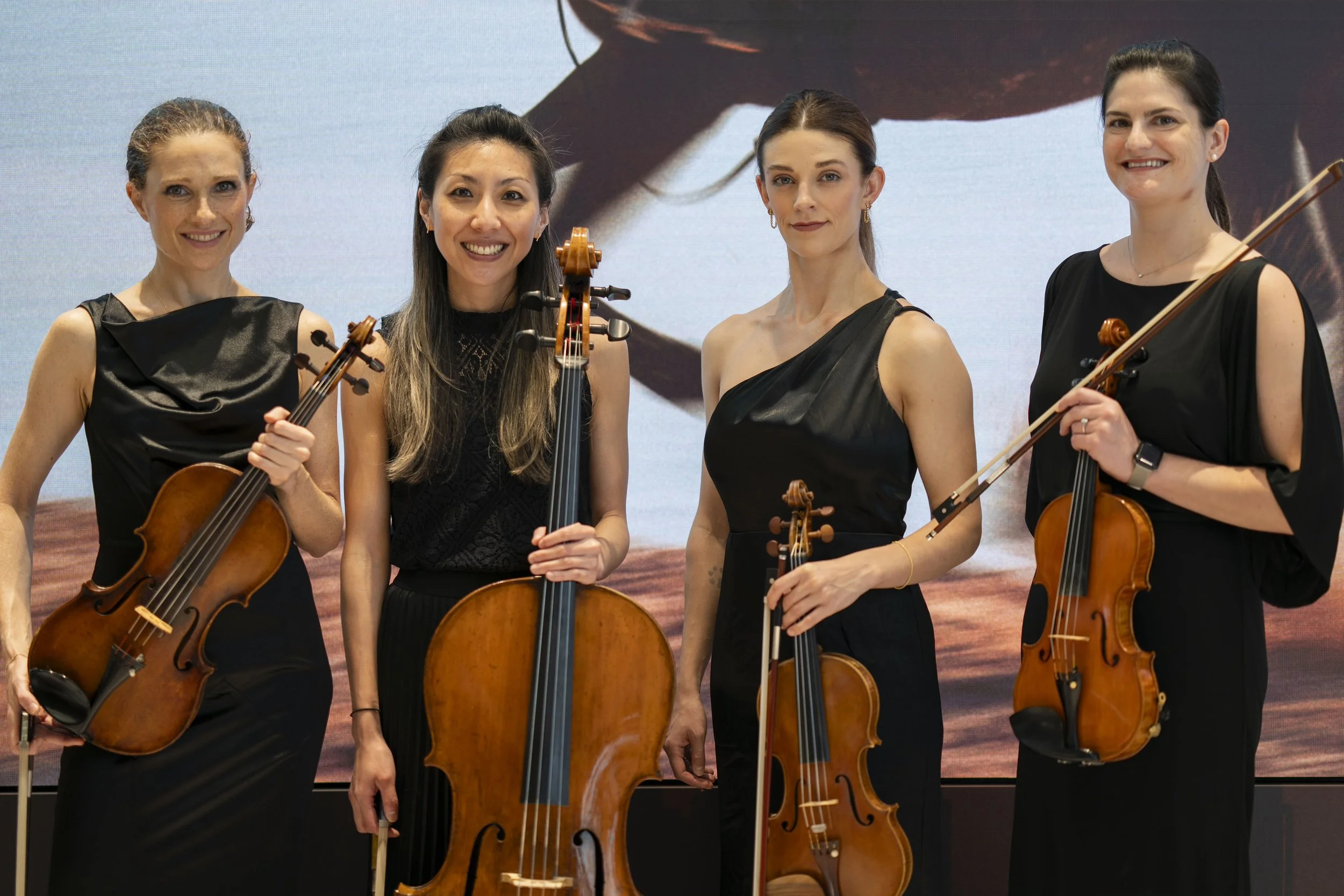
For a Watches of Switzerland brand event, The J.M. Chamber Players provided an all-female string quartet and created a custom arrangement from an audio reference supplied by the client. That type of engagement requires more than a standard set list. It requires interpreting a brand’s request and translating it into a polished live experience.
Awards galas and fundraisers
Galas require music that can operate across multiple phases of an evening.
Strings may be used for guest arrival, cocktail hour, dinner transitions, award walk-ons, sponsor recognition, or a featured performance moment. The ensemble should understand cueing, production communication, microphone considerations, stage changes, and the difference between atmospheric and presentational music.
For nonprofit and fundraising environments, repertoire should support the emotional arc of the evening without making serious moments feel overly produced.
Conferences and summits
A conference reception often needs a distinct change of energy after a day of presentations.
Live strings can transform a meeting venue into a hospitality environment without requiring an entirely separate entertainment concept. They work especially well for opening receptions, VIP dinners, sponsor events, leadership gatherings, and closing celebrations.
Holiday parties
A string quartet can perform seasonal music without limiting the program to holiday standards. Classical selections, contemporary arrangements, jazz, soul, and recognizable seasonal repertoire can be blended into a sophisticated program that feels festive without becoming predictable.
Office openings and corporate milestones
A new headquarters, anniversary, merger celebration, leadership transition, or company milestone deserves a sense of occasion.
Live musicians help distinguish the event from an ordinary office reception. The ensemble may perform at the entrance, near a central architectural feature, or as part of a brief ceremonial moment before transitioning into background music.
String Quartet vs. Playlist vs. DJ vs. Jazz Trio
No single entertainment format is right for every corporate event. The best choice depends on the event’s purpose, guest profile, room, schedule, and desired energy.
| Entertainment Option | Best Suited For | Primary Advantage | Possible Limitation |
|---|---|---|---|
| String Quartet | Executive dinners, galas, client events, luxury activations, and refined receptions | Visually and musically elevated while remaining adaptable | Requires thoughtful placement and professional coordination |
| String Trio | Smaller dinners, offices, private rooms, and intimate receptions | Refined sound with a smaller footprint and budget | Slightly less depth and visual impact in large spaces |
| Curated Playlist | Informal gatherings, budget-conscious events, and transitional periods | Simple and unobtrusive | Cannot respond to the room and offers limited experiential value |
| DJ | Celebrations, dancing, high-energy parties, and late-night programs | Large repertoire and strong energy control | May be excessive for conversation-led hospitality |
| Jazz Trio | Cocktail receptions, social dinners, and lounge-style environments | Rhythmic, relaxed, and sophisticated | Genre identity may be more specific than the event requires |
| Full Band | Large celebrations and featured entertainment | High energy and strong performance impact | Greater production needs, volume, footprint, and cost |
When does a string quartet outperform a playlist?
A quartet is usually the stronger choice when the host wants the music to contribute visibly to the guest experience.
A playlist can fill silence, but it rarely becomes a meaningful point of connection. Guests notice live musicians. They recognize songs. They observe the performance. The room gains a layer of movement and human presence.
For a routine internal gathering, a playlist may be sufficient. For an event intended to build relationships, express appreciation, or elevate brand perception, live performance offers greater value.
Should You Choose a String Trio or String Quartet?
A trio is not simply a budget version of a quartet. Each ensemble has a distinct practical and musical purpose.
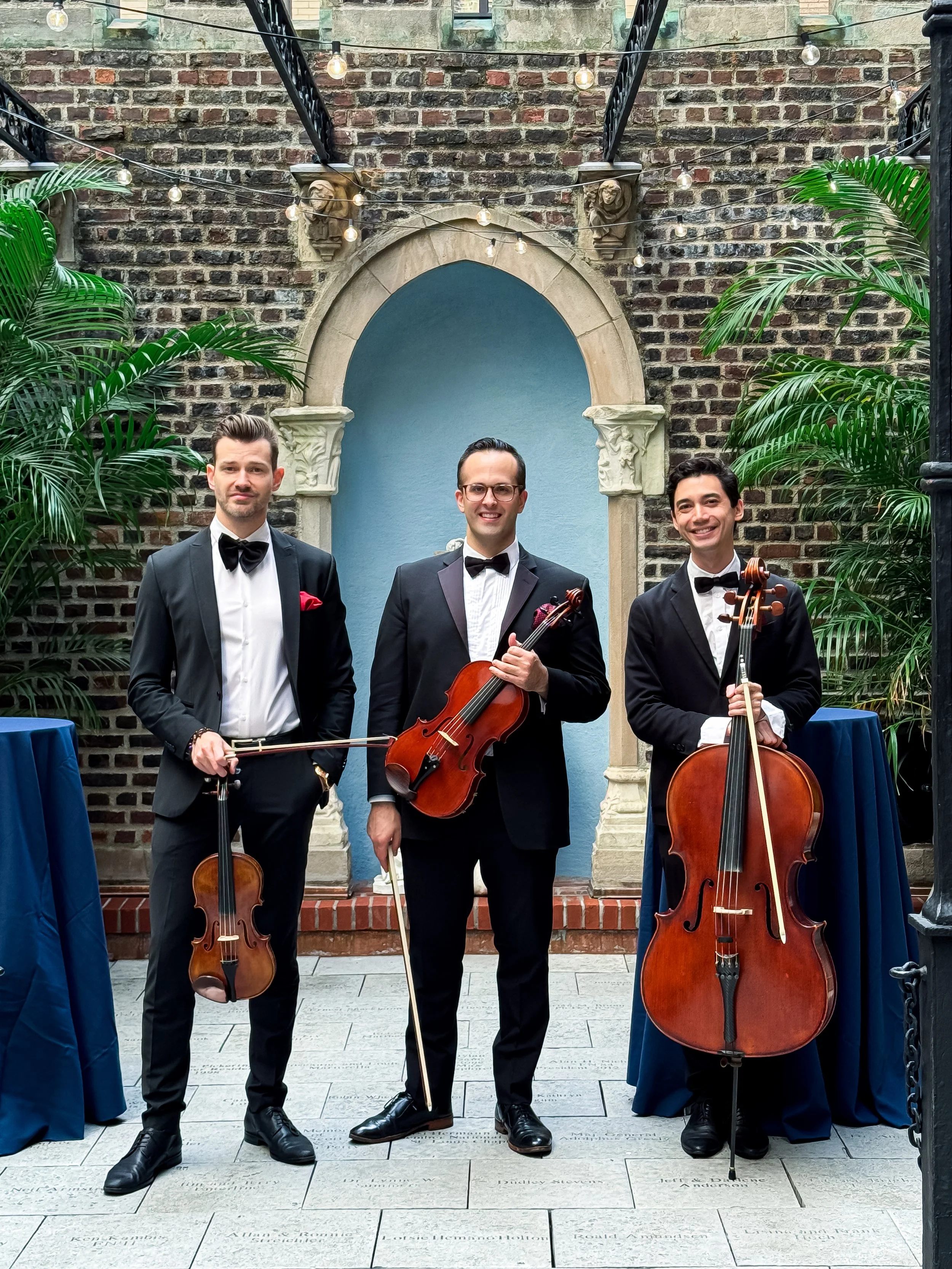
A string trio generally consists of violin, viola, and cello. It offers warmth, clarity, and a refined visual presence with a smaller footprint.
A quartet adds a second violin, creating greater harmonic richness, projection, flexibility, and scale.
| Consideration | String Trio | String Quartet |
|---|---|---|
| Sound | Clear, warm, intimate | Full, layered, expansive |
| Visual Impact | Refined and understated | Stronger and more ceremonial |
| Ideal Guest Count | Small to medium gatherings | Medium to large gatherings |
| Room Size | Private dining rooms, offices, and residences | Ballrooms, galleries, large receptions, and prominent spaces |
| Footprint | Approximately three performance positions | Approximately four performance positions |
| Repertoire | Broad, depending on available arrangements | The widest range of standard string arrangements |
| Budget | More efficient | Higher investment with greater scale |
| Best Use | Conversation-led hospitality | High-impact arrivals, luxury events, galas, and larger rooms |
Choose a trio when the event is intimate, the available footprint is limited, or the music should remain especially subtle.
Choose a quartet when the room needs fuller sound, the ensemble will be visually prominent, the guest count is larger, or the event requires the broadest possible repertoire.
The room’s acoustics matter as much as guest count. Fifty guests in a marble gallery may create more sound competition than 100 guests seated in a carpeted private club. An experienced provider should ask about the venue, layout, ceiling height, surfaces, schedule, and expected social energy before making a recommendation.
“The right ensemble size is determined by the room, not by a formula.”
What Music Should a String Quartet Play at a Corporate Event?
The best corporate repertoire sounds intentional without feeling overly programmed.
A successful program usually combines recognizable contemporary music, timeless standards, and selected classical works. The precise balance depends on the company, event format, guest profile, and brand identity.
Contemporary pop and crossover
Modern arrangements can help a string ensemble feel current while preserving an elegant sound.
Appropriate artists may include:
Alicia Keys
Coldplay
Stevie Wonder
Bruno Mars
Taylor Swift
The Beatles
David Bowie
Beyoncé
Frank Ocean
Adele
Elton John
Earth, Wind & Fire
The objective is not to reproduce a commercial recording exactly. The value lies in hearing familiar material reinterpreted through live strings.
Soul, jazz, and timeless standards
Standards work particularly well for cocktail receptions, private dinners, luxury hospitality, and multigenerational audiences.
Selections might draw from:
Frank Sinatra
Ella Fitzgerald
Nat King Cole
Louis Armstrong
Etta James
The Temptations
Bill Withers
Marvin Gaye
Antônio Carlos Jobim
George Gershwin
Classical repertoire
Classical music remains highly effective when chosen with the environment in mind.
Mozart, Bach, Handel, Vivaldi, Debussy, Ravel, and Tchaikovsky can create clarity, movement, and refinement. Shorter, recognizable works often suit receptions better than long-form concert repertoire.
Classical selections can be particularly appropriate for museums, historic venues, donor events, ceremonies, and formal arrivals.
Film and instrumental music
Film scores and instrumental themes can create atmosphere without introducing lyrics or overly familiar pop associations. They may work especially well for awards events, presentation transitions, and brand environments with a cinematic creative direction.
Custom arrangements
A custom arrangement can connect the performance directly to a company, honoree, campaign, city, or event theme.
Because arranging requires preparation, music sourcing, and rehearsal, custom requests should be discussed early. The client should also clarify whether the request is intended as subtle background repertoire or a featured moment.
Repertoire to approach carefully
Not every recognizable song is right for every room.
Songs with strong romantic associations may feel misplaced at a financial or legal event. Aggressive rhythmic arrangements may interfere with conversation. Novelty selections may momentarily entertain but weaken an otherwise coherent luxury environment.
A premium ensemble should curate rather than merely provide a giant song list.
Repertoire Principle
Corporate repertoire should be familiar enough to create connection, restrained enough to preserve the room, and varied enough to support the entire event without calling attention to every transition.
NYC Venue Considerations for Live String Music
New York City offers extraordinary event spaces, but each venue introduces its own operational requirements.
Hotels
Hotels often provide established loading procedures, vendor entrances, freight elevators, security requirements, insurance standards, and designated holding areas.
The planner should confirm:
Vendor access time
Loading entrance
Freight-elevator reservation
Certificate of Insurance requirements
Performance location
Green room or holding space
House sound availability
Power access if amplification is required
Parking or unloading procedures
Restrictions on cases and equipment in guest areas
Hotel ballrooms may absorb sound, while marble lobbies and pre-function areas may reflect it dramatically. The ensemble should understand the specific room rather than treating all hotel events alike.
Private clubs
Private clubs often require discretion, traditional etiquette, and coordination with an experienced in-house team.
Space may be limited, particularly in private dining rooms. Musicians may need to enter through a service route, store cases out of sight, and adjust performance timing around formal dinner service.
A trio can be especially effective in a compact club room, while a quartet may be preferred for a library, ballroom, terrace, or larger reception area.
Rooftops
Rooftops introduce wind, temperature, sun exposure, unstable flooring, and sound-projection challenges.
String instruments are sensitive to weather. Direct sun, moisture, extreme heat, cold, and wind can damage instruments or make safe performance impossible.
A rooftop plan should address:
Covered backup location
Stable, level flooring
Protection from direct sun
Temperature
Wind exposure
Secure music stands
Amplification needs
Electrical access
Weather decision deadline
A beautiful skyline is not, by itself, a sufficient performance plan.
Museums and galleries
Museums and galleries offer strong visual alignment with string music, but acoustics can be highly reflective.
Volume must be controlled carefully, and the ensemble’s placement should respect artwork, guest circulation, security boundaries, and catering routes. Some institutions also have strict loading times, approved vendor lists, and restrictions on electrical equipment.
Corporate offices
Office events may take place in a lobby, conference room, café, terrace, trading floor, or newly opened headquarters.
The planner should consider whether employees will continue working nearby, where guests will arrive, how security will process vendors, and whether furnishings must be moved.
Modern offices can contain many hard surfaces, so a modest acoustic ensemble may carry farther than expected.
Restaurants and private dining rooms
Restaurants require close coordination with service.
The musicians should not block server pathways, kitchen access, guest sightlines, or emergency routes. Performance volume may need to change once guests sit, and breaks should be timed around speeches, courses, and transitions.
Historic residences and townhouses
Private residences can create an exceptionally intimate experience, but access may involve narrow stairs, limited loading space, delicate furnishings, and few storage options.
The cello requires particular attention because it cannot always navigate the same routes as smaller instruments. Measurements and photographs may be useful when access is uncertain.
Do Corporate Events Need Amplification?
Not every corporate event requires amplification.
For a quiet dinner, gallery reception, private room, or modest guest count, acoustic performance may be ideal. For a large reception, outdoor event, highly absorptive ballroom, or space with significant ambient noise, amplification may improve clarity and consistency.
Amplification should not automatically mean louder. Its purpose may be to distribute the ensemble’s sound evenly so the musicians do not need to play aggressively.
The decision should consider:
Guest count
Room size
Ceiling height
Surface materials
Outdoor exposure
Bar and catering noise
Speaking program
Distance between musicians and guests
Whether guests will be seated or standing
Whether the venue has an existing sound system
Whether a sound technician is available
When sound reinforcement is included, the provider should clarify who supplies the microphones, mixer, speakers, cabling, power, setup labor, and on-site operation.
How Far in Advance Should You Book?
For a corporate string quartet in NYC, three to six months is a comfortable planning window for many events. High-demand dates, complex productions, holiday periods, and engagements requiring custom arrangements should be booked earlier.
Short-notice bookings are sometimes possible, but advance planning improves access to the strongest-fit musicians, allows more thoughtful repertoire development, and gives the venue sufficient time to process insurance and production requirements.
Recommended planning timeline
| Time Before Event | Recommended Actions |
|---|---|
| 6–12 Months | Reserve priority dates for major galas, conferences, holiday events, or complex brand activations. |
| 3–6 Months | Confirm ensemble size, event schedule, venue, performance role, and preliminary repertoire direction. |
| 6–12 Weeks | Finalize production requirements, attire, access, custom arrangements, and major musical moments. |
| 2–4 Weeks | Confirm the timeline, addresses, contacts, load-in, holding space, sound requirements, and cueing. |
| Final Week | Review the latest run of show and communicate any material changes. |
| Event Day | Coordinate through one designated planner, producer, or on-site contact. |
For recurring corporate programs, preferred dates can be held or planned as part of a broader seasonal calendar.
What Affects the Cost of a Corporate String Quartet in NYC?
Corporate string-quartet pricing is influenced by more than the number of minutes the musicians perform.
The most important pricing factors include:
Ensemble size
Event duration
Total on-site time
Date and demand
Venue location
Load-in complexity
Rehearsal requirements
Custom arrangements
Amplification and sound support
Attire or styling requests
Early arrival requirements
Multiple performance locations
Break structure
Overtime contingencies
Travel or parking
Production coordination
Insurance and administrative requirements
A one-hour performance at an accessible Manhattan venue is a different engagement from a four-hour brand activation involving custom music, extended load-in, sound reinforcement, wardrobe direction, and coordination with a production agency.
A professional proposal should state clearly what is included, how overtime is handled, what the venue must provide, and which changes could affect the final investment.
What are you paying for beyond the performance?
Premium corporate pricing may include:
A vetted roster of accomplished professional musicians
Thoughtful ensemble matching
Contracting and scheduling
Repertoire consultation
Music preparation
Venue and production coordination
Insurance documentation
Timeline review
Professional attire
Early arrival and setup
Contingency planning
A designated point of contact
Replacement coverage in case of emergency
Reliable communication before and during the event
The lowest quote may cover musicians playing music. A premium proposal should cover the larger responsibility of delivering the experience reliably.
For a detailed breakdown of pricing, see our guide to How Much Does a String Quartet Cost for a Corporate Event in NYC?
Common Mistakes Corporate Event Planners Should Avoid
Choosing entertainment before defining its role
“Live music” is not a complete brief.
Determine whether the ensemble is meant to welcome guests, support networking, accompany dinner, create a branded moment, perform a feature, or manage several of those roles.
Booking solely from a set list
A long repertoire list does not prove that a group understands corporate hospitality.
Evaluate communication, presentation, operational experience, sound judgment, and the provider’s ability to recommend what should not be played as carefully as what can be played.
Ignoring acoustics until event day
Room materials, guest density, catering noise, ceiling height, and performance placement all affect sound.
Share photographs, floor plans, or venue details early.
Placing musicians in leftover space
The ensemble should be integrated into the floor plan, not added after every other element has been positioned.
Allow space for chairs, stands, instruments, safe movement, cases, cables when applicable, and separation from food service.
Positioning the ensemble beside the bar
Bars create lines, glass noise, conversation clusters, refrigeration sound, and service traffic. This is often one of the least effective locations for acoustic musicians.
Treating amplification as an afterthought
Determine who is supplying and operating sound equipment. Do not assume the venue’s installed system is designed for string instruments.
Over-programming the repertoire
The music should feel curated, not anxious to demonstrate range. A coherent atmosphere is usually more valuable than moving abruptly among unrelated styles.
Failing to establish one on-site contact
Musicians should know who can make decisions about timing, placement, cues, and changes. Conflicting direction from multiple stakeholders creates unnecessary risk.
Neglecting breaks and overtime
Long engagements require a defined performance-and-break structure. The contract should also explain what happens if the event runs late.
Hiring for musical skill alone
Exceptional playing is essential, but corporate events also require punctuality, discretion, attire, communication, adaptability, and awareness of the client environment.
What Makes a Corporate String Quartet Premium?
A premium ensemble is defined by consistency across the entire engagement.
The musicians should play at a high level, but the client should also experience:
Clear, timely communication
A sophisticated understanding of the event’s purpose
Practical venue guidance
Thoughtful repertoire curation
Appropriate attire and presentation
Respect for planners, venues, guests, and production teams
Calm adaptation to schedule changes
Controlled volume
Reliable contracting and documentation
Professional contingency planning
The ensemble should understand that a client dinner is not a wedding, a museum gala is not a retail activation, and a hedge-fund reception is not a public concert.
Each room requires a different calibration.
Why Luxury Brands and Financial Firms Choose Live Strings
Organizations operating in high-trust, high-value environments are often cautious about entertainment.
The event must feel distinctive, but not frivolous. It should communicate quality without creating reputational risk. Guests may include clients, investors, partners, donors, executives, press, public figures, or international stakeholders.
String music fits these environments because it can express refinement without relying on spectacle.
Financial firms and hedge funds
Financial-sector events often prioritize discretion, conversation, and client hospitality. A quartet can elevate the setting while allowing business relationships to remain the central focus.
The ensemble’s punctuality, attire, sound level, and ability to follow a precise run of show may matter as much as the repertoire.
Law firms
Law-firm receptions may bring together partners, clients, alumni, recruits, and professional networks. The music should feel polished and socially intelligent without making the event seem overly ceremonial.
Strings are especially well suited to office openings, partner dinners, client receptions, anniversary events, and cultural-institution partnerships.
Luxury brands
Luxury brands frequently require every element of an event to align with a visual and experiential identity.
A string ensemble can be styled, positioned, and programmed to complement a campaign while preserving the human craftsmanship associated with live performance.
Professional-services firms
Consulting, real-estate, architecture, technology, and other professional-services firms often use live strings for openings, leadership events, client appreciation, recruiting, anniversaries, and conference hospitality.
The ensemble creates a meaningful shift from the everyday work environment into a hosted experience.
The J.M. Chamber Players’ Approach to Corporate Events
The J.M. Chamber Players provides luxury string ensembles for corporate, private, and wedding events throughout New York City.
Our roster includes accomplished New York musicians with experience in leading concert halls, major cultural institutions, Broadway productions, recording environments, and high-level private events. But technical musicianship is only the foundation of our corporate work.
Our approach centers on calibration.
We consider:
What the event is meant to accomplish
Who will be in the room
How guests should feel when they arrive
Whether conversation or performance is primary
How the music should evolve over the evening
What the venue permits
How the ensemble should look within the design
Which repertoire supports the client’s identity
Where volume should sit
How musicians will coordinate with the planner and production team
What contingencies should be resolved before event day
We offer string trios, quartets, and expanded custom ensembles, with optional sound support when appropriate. Programs may include classical repertoire, contemporary arrangements, jazz and soul standards, film music, and commissioned selections.
The result should not feel like entertainment placed into a room. It should feel as though the music belongs to the event.
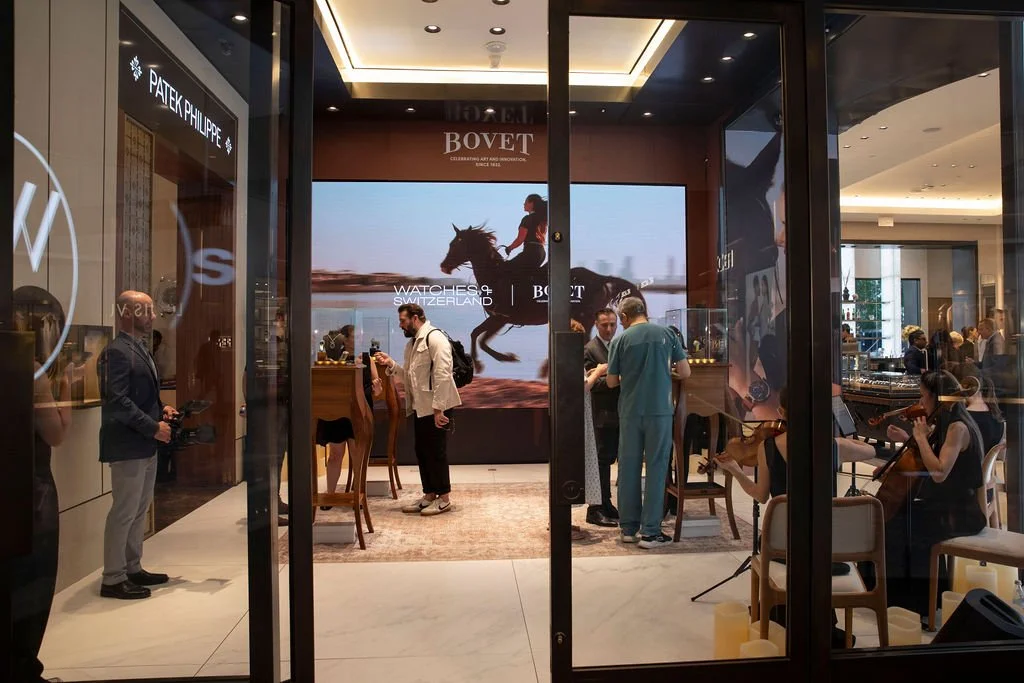
The J.M. Chamber Players performing for a Watches of Switzerland and BOVET brand event in New York City.
“I recently had the pleasure of working with The J.M. Chamber Players on a brand event, and was completely blown away by the expert coordination, accommodation, and talent the group brought to the table.”
How to Request a Corporate Event Proposal
A useful corporate music proposal begins with context.
When contacting an ensemble, provide as much of the following information as possible:
Event date
Venue and neighborhood
Guest count
Event type
Approximate schedule
Performance duration
Indoor or outdoor setting
Desired role of the music
Preferred ensemble size, if known
Repertoire direction
Speaking program
Production or amplification needs
Attire expectations
Planning or agency contact
Budget range, when available
It is not necessary to have every detail decided. A premium provider should be able to recommend the right ensemble and format based on the information available.
Planning a corporate event in New York City?Request a tailored recommendation from The J.M. Chamber Players. We will help you determine the right ensemble, performance format, repertoire direction, and production approach for your venue and guests.
Frequently Asked Questions
Is a string quartet appropriate for a corporate event?
Yes. A professional string quartet is well suited to executive dinners, client receptions, awards galas, fundraisers, conferences, office openings, holiday parties, and luxury brand activations. The repertoire, attire, volume, and presentation should be tailored to the event rather than treated as a standard concert program.
Will a string quartet be too formal?
Not when the program is curated appropriately. Contemporary pop, soul, jazz, rock, film music, and classical repertoire can all be arranged for strings. The ensemble can feel traditional, modern, understated, fashion-forward, or celebratory depending on the event.
Can guests still talk while the quartet performs?
Yes. A string ensemble can maintain a controlled volume that supports conversation. Placement, acoustics, guest count, repertoire, and amplification all affect the result, so these factors should be reviewed during planning.
Is a trio or quartet better for a corporate reception?
A trio is often ideal for intimate rooms, smaller guest counts, and conversation-led events. A quartet provides greater musical depth and visual presence for larger receptions, ballrooms, galas, and luxury activations.
How much space does a string quartet need?
The exact footprint depends on the setup, but each musician needs a stable chair, music stand, and sufficient room to move safely with the instrument. Additional space may be required for microphones, speakers, cables, cases, or multiple performance areas.
Does a string quartet need electricity?
An acoustic performance does not require electricity. Power is needed when amplification, lighting, or other production equipment is included.
How loud is a string quartet?
Volume depends on repertoire, room acoustics, musician placement, and whether amplification is used. Acoustic strings can be subtle in a private dining room but carry strongly in a reflective marble or glass space.
Can a quartet perform outside?
Yes, provided the instruments are protected from direct sun, precipitation, extreme temperatures, wind, and unstable conditions. A covered backup location should always be established.
Can the musicians perform modern music?
Yes. Professional corporate string ensembles commonly perform contemporary pop, soul, rock, jazz standards, film music, and other recognizable repertoire alongside classical works.
Can we request a custom song?
Often, yes. If a suitable arrangement does not already exist, a custom arrangement may be commissioned. Requests should be made early enough to allow for arranging, preparation, and rehearsal.
Can the quartet coordinate with speeches and presentations?
Yes. The ensemble can coordinate starts, stops, transitions, walk-on music, recognition moments, and other cues with the planner or production team. A final run of show and one designated on-site contact are strongly recommended.
Do the musicians take breaks?
For longer engagements, yes. Break structure should be stated in the agreement and coordinated with speeches, dinner service, presentations, or other program elements.
How far in advance should we book a corporate string quartet in NYC?
Three to six months is a comfortable window for many events. Major galas, holiday dates, complex activations, and events requiring custom arrangements should be booked earlier when possible.
What should the venue provide?
Typical requirements may include armless chairs, sufficient performance space, safe access, protection from weather, and a holding or storage location. Specific needs depend on the ensemble, venue, and production plan.
What should be included in a professional proposal?
The proposal should specify ensemble size, performance schedule, total on-site time, repertoire or customization, attire, sound requirements, breaks, overtime terms, venue responsibilities, payment terms, and any additional production services.
Can a string quartet perform in a corporate office?
Yes. Offices, lobbies, terraces, cafés, and conference spaces can all work well. Security access, freight elevators, loading, nearby employees, acoustics, and furniture placement should be considered in advance.
Is a string quartet suitable for a networking event?
Yes. Strings are particularly effective for networking events because they can create energy and atmosphere while remaining controlled enough for conversation.
Can the ensemble match our brand aesthetic?
Yes. Repertoire, attire, ensemble composition, layout, and presentation can be discussed as part of the creative brief. Any specialized wardrobe or production request should be confirmed early.
Do we need amplification for a large event?
Possibly. Large rooms, outdoor settings, high ambient noise, or widely distributed guests may benefit from amplification. The objective should be even sound coverage rather than unnecessary volume.
Why hire The J.M. Chamber Players for a corporate event?
The J.M. Chamber Players combines accomplished New York musicianship with detailed event coordination, repertoire curation, venue awareness, polished presentation, and a discreet understanding of executive and luxury environments. Each engagement is designed around the room, guests, and purpose of the event.
Final Perspective
A string quartet can do more than provide background music for a corporate event.
It can establish the tone before a host says a word. It can make an office feel ceremonial, a ballroom feel more intimate, a retail environment feel more human, and a client dinner feel genuinely hosted.
Its success, however, depends on more than hiring four musicians.
The right ensemble must understand when to be heard, when to recede, how to read a room, how to work within a venue, how to support a planner, and how to translate a company’s intentions into an experience guests can feel.
That is where live music becomes more than entertainment.
It becomes part of the hospitality.